
From Purchase Price To Running Costs: Calculating The True Cost Of Malaysia’s Cheapest Evs


Not too long ago, electric vehicles were hardly something you would see every day in Malaysia. If a Tesla (one of the best known EVs) passed by, most of us would just look and think it was way out of our budget anyway. But fast forward to 2025 and things have changed. In Malaysia, EV registrations have surged from about 13,300 in 2023 to nearly 22,000 in 2024 and by October 2025 the number had already passed 31,000, making electric cars a far more familiar sight compared to just a couple of years ago. EVs now account for roughly 5 to 6 percent of monthly new car registrations, a small but fast-growing slice of Malaysia’s automotive landscape.
More importantly, these aren’t just premium imports anymore. From compact options like the Neta V to stylish picks like the BYD Dolphin, EVs are slowly feeling more within reach for everyday Malaysians. And in a milestone shift, Perodua has introduced its first full battery-electric model– the QV-E, priced at around RM 80,000, excluding insurance, just weeks after Proton entered the market with its own EV e.MAS. With both national automakers now in the race, the idea of driving electric has never felt closer to home.
Still, there is a lot more to an EV than just the selling price. The real cost of owning one includes charging, maintenance and even insurance. So before deciding whether to go electric, it is worth looking at what Malaysia’s most affordable EVs actually cost to run once they leave the showroom.
What really counts as “cheap” in Malaysia’s EV market?
Before we call an EV “cheap”, let’s first put things into perspective. Right now, the Perodua QV-E appears to be setting a new entry-level benchmark. For many Malaysians, that’s still a big commitment but if you compare it to hybrid cars or the more premium EVs that used to dominate the roads, it is a lot more accessible.
Other affordable EV contenders still include Neta V at around RM100,000 and BYD Dolphin Dynamic Standard at RM100,530.
| Model | Estimated Starting Price in Malaysia | Range |
|---|---|---|
| Proton e.MAS | ~RM105,800 | ~345 km* |
| Perodua QV-E | ~RM80,000 | ~445km* |
| Neta V | ~RM100k | ~380 km |
| BYD Dolphin Dynamic Standard Range | RM100,530 | ~340 km |
These are compact, urban-friendly EVs that appeal to first-time EV buyers or folks looking to switch from petrol to electric without busting their savings. On paper, the QV-E’s pricing looks especially appealing. Add in the fact that import and excise duties on EVs remain waived until December 2025 and the upfront cost becomes even more attractive.
But the real question is this: once you own it, will your wallet still be grateful in the long run?
Powering up: Electricity vs petrol
One of the biggest advantages of owning an EV in Malaysia is the cost of “fuel.” Charging an electric car is significantly cheaper than filling up a tank with RON95. Let’s do some quick maths here.
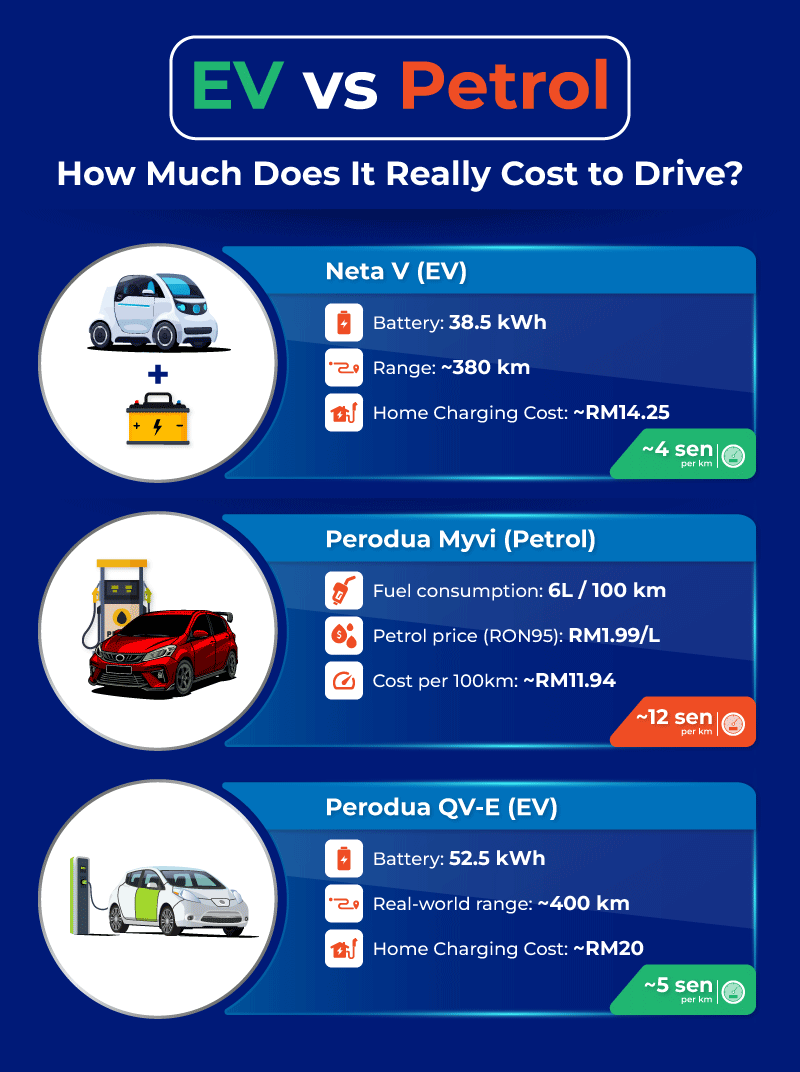
So yes, running an EV can be 50–60% cheaper per kilometre, provided you charge at home. Public DC fast chargers, while convenient, can be pricier at RM1.20–RM1.50 per kWh, roughly tripling the cost per kilometre. It’s a trade-off between convenience and cost, much like paying for delivery instead of cooking at home.
Servicing and maintenance: Fewer moving parts, fewer headaches
If you’ve ever dealt with an oil change, spark plug replacement or leaky gasket, you’ll love what comes next. EVs don’t have engines in the traditional sense, which means far fewer components to service.
A petrol car might need servicing every 10,000 kilometres, with each session costing between RM200 and RM400. Over five years, that’s roughly RM3,000–RM4,000 if you actually do follow the recommended guidelines. Meanwhile, EV maintenance seems comparatively simpler: no oil changes, no fuel filters and no transmission issues. You’re mainly looking at tyre rotations, brake fluid changes and the occasional cabin filter replacement. The total over five years? Roughly RM1,500–RM2,000, depending on mileage and workshop rates. However, battery issues or changes may incur a high cost.
However, for the Perodua QV-E, this might not be an issue thanks to its Battery-as-a-Service (BaaS) model. Instead of fully owning the battery, Perodua monitors its health and will replace it if its capacity drops below 70 per cent. Paired with a 6-year or 150,000 km warranty and separate drive-unit coverage, this helps protect buyers from unexpected, high-ticket battery repairs, the part many EV owners worry about most.
From a manufacturer’s perspective, this subscription-style model keeps the vehicle’s upfront price lower and allows Perodua to take responsibility for the most complex component in the car. However, it does come with a recurring monthly battery rental fee. That predictable long-term cost is exactly what some buyers are unsure about, even if it avoids the risk of a huge one-off replacement bill later on.
This battery strategy is still new in Malaysia and makes Perodua one of the first local brands to use it for a mass-market EV. It will be interesting to see how Malaysians respond once the full rental pricing is confirmed and whether the lower upfront cost ultimately outweighs the monthly commitment for everyday drivers. Either way, the QV-E is pushing EV ownership into new territory and that’s worth considering when comparing the real cost of going electric.
But beyond maintenance, there are also other costs that aren’t always obvious to first-time EV buyers.
The hidden costs of insurance and road tax
Now, here’s where things get interesting. EVs have unique insurance and road tax calculations that can catch first-time buyers off-guard. While road tax for EVs is currently exempt until December 2025, the exemption might not last forever. The government has hinted that a new, weight-and power-based system could come into play post-2025.
Insurance, meanwhile, can be a mixed bag. Since EVs often cost more to repair, mainly because of expensive batteries and limited specialist workshops, premiums tend to be about 10–15% higher than comparable petrol cars.
That said, insurers such as Allianz and Etiqa have started offering EV-specific plans that include roadside charging assistance, coverage for wall-box chargers and towing to certified EV workshops. This will likely continue to expand as other insurers catch up and more EVs continue to hit the roads.
Costs of charging at home
Before you can enjoy the cheap charging costs, you’ll likely need to install a home wall charger, which can range between RM3,000 and RM7,000 depending on brand and speed. TNB and other partners sometimes offer rebates or package deals, so it’s worth checking when you purchase.
You can technically charge using a normal three-pin socket, but it’s painfully slow, imagine waiting 20 hours for a full battery. Most EV owners install at least a 7 kW charger, which can fully charge a small EV like the Dolphin in about 6 hours.
Incentives, rebates and freebies
This is where Malaysia’s EV push gets exciting or at least offers the most impact on your savings. Car brands are now competing to offer creative incentives to lure buyers. For example: BYD has offered free home charger installation and a five-year warranty. Great Wall Motors (Ora Good Cat) bundles roadside assistance and complimentary charging credits. Some new showrooms even throw in free insurance for the first year.
Meanwhile, the government’s EV ownership incentives include duty exemptions, tax reliefs of up to RM2,500 on EV chargers and rebates under the Low Carbon Mobility Blueprint. Add that up and you’re looking at savings of several thousand ringgit, especially if you time your purchase right.
Battery rental: How much does it change the Math?
Battery rental will play a major role in determining the QV-E’s true long-term affordability. While exact subscription fees are still being finalised at the time of writing, analysts expect the monthly cost to be based on battery size and usage duration.
In practice, this splits EV ownership into two cost layers: the car itself and the energy storage powering it. For first-time buyers, this can actually make the EV more accessible, since the largest single component- the battery is not fully paid for upfront. However, Malaysians comparing between Neta V, BYD Dolphin and QV-E will want to decide whether the monthly rental still adds up to long-term savings.
So, what’s the “true cost”? Let’s run a simple five-year projection for the Neta V (assuming 15,000 km per year):
| Cost Component | Estimated 5-Year Cost |
|---|---|
| Electricity (home charging) | RM1,650 |
| Maintenance | RM2,000 |
| Insurance | RM7,000 |
| Road tax | RM0 (until 2025) |
| Home charger setup | RM5,000 (one-off) |
| Total (excluding purchase price) | RM15,650 |
That’s just over RM3,000 per year in running costs, significantly less than what you’d pay for a similar petrol car, which can easily exceed RM5,000 per year once fuel, servicing and road tax are included.
As of now, Perodua has not confirmed if its QV-E purchase packages will include home charger installation or charging credits but any bundled incentives could further reduce upfront cost for first-time EV buyers.
Final thoughts
Buying Malaysia’s cheapest EV isn’t just about going green or showing off your futuristic ride; it’s about rethinking what “affordable” really means. While the upfront cost may still be higher than a Myvi or Axia, the long-term savings on fuel and maintenance can make it a smart financial decision, especially with ongoing government incentives and falling battery prices.
And with Perodua’s first EV entering the market at a much lower price point, owning an electric car is slowly shifting from a “nice to have” to something Malaysians can realistically plan for.
EVs may have started as a novelty, but they’re fast becoming a practical choice for urban Malaysians who want efficiency, sustainability and a little style. Just remember to factor in all the costs, from the plug to the parking lot, before you decide if an electric future truly fits your budget.