First Home Stamp Duty Exemption 2027: Should You Sign Now Or Wait Until January?


Table of Contents
Between RM500,001 and RM750,000, the date on your SPA is worth five figures; outside that band it is worth nothing. The two-line check takes ten minutes.
The two-line check for the first home stamp duty exemption 2027, as proposed in Budget 2027: compare your price with RM500,000 and RM750,000. At or under RM500,000, December and January cost the same: nothing. Between the lines, a January 2027 SPA cuts transfer duty by RM9,000 plus 1.5% of the price above RM500,000. Above RM750,000, the date changes nothing.
You’ve found the one. Three bedrooms, a balcony that catches the evening breeze, a school close enough to walk to. The bank has said yes. The sales adviser has said ‘year-end’ more times than you can count. And a small voice wants it signed before 31 December, so 2027 starts with a home.
Hold that pen for a second.
If your first home costs more than RM500,000 but no more than RM750,000, the same signature on the same agreement costs less in January. On a RM700,000 home, the transfer duty alone drops by RM12,000. Count the loan agreement and it’s about RM14,700. That’s an illustrative example; the workings are below.
That isn’t a discount you negotiate. It’s a date.
And if your home costs RM500,000 or less, December and January cost exactly the same in stamp duty: nothing. Waiting buys you nothing. So the real question was never ‘now or January’. It’s which side of two lines your price sits on.
What Budget 2027 changed for the first home stamp duty exemption
Right now, a Malaysian citizen buying a first home with a market value up to RM500,000 pays no stamp duty on the transfer or on the loan agreement. That rule covers SPAs executed up to 31 December 2027 (Bar Council circular, April 2026). One ringgit over RM500,000 and you get nothing. Not a smaller exemption. Nothing.
Budget 2027, tabled on 9 October, proposes a wider rule for SPAs executed from 1 January 2027 to 31 December 2030 (Bernama, on the Finance Ministry’s tax measures; The Star, 9 October):
- Up to RM500,000: still fully exempt.
- RM500,001 to RM750,000: the first RM500,000 fully exempt, 50% off the rest.
- Above RM750,000: no exemption.
One caveat, and it isn’t small print. This is what was announced, not yet the law. The exemption order that gives the rule legal effect, and any Finance Bill changes, will confirm the final wording. The last time this exemption was redrawn, the order was gazetted on 10 February 2021 and deemed to start on 1 January. So before you plan a January signing around it, ask your lawyer whether the order is out, and how they’ll handle the stamping if it isn’t. (It’s one of the three Budget lines that need you before a date, as we set out in Three Things In Budget 2027 Need You.)
Updated 3 November 2026. The RM500,001 to RM750,000 tier is a Budget 2027 proposal for SPAs executed from 1 January 2027 to 31 December 2030. In the sources we checked, the exemption order that gives it legal effect had not been reported as gazetted.
Still open: whether the order is gazetted before 1 January; how the 50% applies to a loan agreement above RM500,000; whether the RM750,000 limit tests price or the valuer’s market value; and the treatment of serviced apartments, SOHO and joint purchases. We update this page when each one is confirmed. Sources: Bernama (Ministry of Finance Budget 2027 Tax Measures), The Star, Bar Council Circular 128/2026.
How much does a January SPA save? Two first homes compared
Two first-time buyers, both borrowing 90%. The figures are illustrative.
| RM450,000 home | RM700,000 home | |
|---|---|---|
| Loan at 90% | RM405,000 | RM630,000 |
| Stamp duty with no exemption | RM10,025 | RM18,150 |
| SPA signed in December 2026 | RM0 | RM18,150 |
| SPA signed in January 2027 | RM0 | about RM3,450 |
| What January saves | RM0 | about RM14,700 |
Stamp duty with no exemption is the transfer duty (RM8,000 and RM15,000) plus 0.5% on the loan agreement (RM2,025 and RM3,150), on the standard scale set out in our guide to the upfront costs of buying a home.
The RM450,000 buyer is covered either way. The exemption is worth about RM10,000 to them; the date is worth nothing.
The RM700,000 buyer is where the date decides. Transfer duty drops from RM15,000 to RM3,000. The loan agreement drops from RM3,150 to roughly RM450. The Budget papers don’t yet say how the 50% is split on a loan above RM500,000, so treat that last figure as an estimate.
Somewhere between the lines? Here’s the shortcut for transfer duty: January saves RM9,000, plus 1.5% of every ringgit above RM500,000. At RM600,000 that’s RM10,500. At RM750,000, RM12,750.
Now put RM14,700 into a life. It’s about five months of instalments on that RM630,000 loan (illustratively, at 4.5% over 35 years, around RM2,980 a month). And it sits on top of the price and the deposit, not inside them. If you’d like to see the instalment on your own numbers, iMoney’s home loan calculator is free and asks for nothing.
One more thing if you’re close to RM500,000. The current rule tests the government valuer’s market value, not just the price on your SPA. If a RM500,000 home is valued at RM505,000, the current rule gives you nothing: about RM11,400 in duty. The proposed one would charge less than RM100. Close to the line, January is the safer month.
When is an SPA ‘executed’? What counts for the first home stamp duty exemption
Every version of this rule hangs on one date: when the sale and purchase agreement is executed. That’s narrower than it sounds.
- The booking fee isn’t the agreement. Paying it in December doesn’t put you under December’s rule. But your booking form usually sets a deadline for signing the SPA, and missing it can cost you the unit, sometimes the fee. Read it before you ask for a January date.
- The bank’s letter of offer isn’t the agreement either. Its date doesn’t decide which rule applies. Under the current rule, even the loan agreement’s exemption follows the SPA’s date, and the Budget 2027 proposal is framed the same way.
- The SPA is. Aim for both signatures, yours and the seller’s, to land on or after 1 January 2027.
- The date has to be real. A December signature with a January date on it isn’t a saving. It’s a false document, and you’ll have signed it.
Two more things are worth a call to your lawyer. If the home is a serviced apartment or SOHO, the current rule is disputed: the Stamp Act’s definition includes them, the tax office’s declaration form excludes them, and in April the Bar Council said it would ask for the form to be fixed (Circular 128/2026). And if you’re buying jointly with someone who has owned a home before, the current rule exempts only the first-timer’s share.
What waiting until January could cost you
January isn’t free. Price the wait before you ask for it.
The price. A price on a booking form is only as good as its expiry date. Push the SPA past it and the developer can ask you to rebook, possibly at a new price. On a subsale, the owner can simply say no. Developers have read the Budget too.
The unit. If it’s the corner unit, the high floor, the one ten minutes from your parents, someone may sign for it in December. Decide what that’s worth to you, in ringgit, and set it beside the saving.
December’s sweetener. Some year-end campaigns come with rebates or free legal fees. Put that number next to the January saving. On a RM700,000 home, a RM5,000 rebate doesn’t beat RM14,700. A RM20,000 one does.
The loan offer. Your bank’s letter of offer runs on its own clock: a deadline to accept, and usually a date by which the loan documents must be signed. If that second date lands before a January SPA can, you may have to apply again, and the bank takes a fresh look at your income, your commitments and the property’s value. If your offer will run out before January, or you’re not sure the bank would say yes twice, iMoney Home Advisory will look at your numbers; the first assessment is free.
And if your price is RM500,000 or less, all of this is cost with nothing on the other side. Sign when you’re ready.
From a cliff to a slope: why the SPA date suddenly matters
Three contrasts explain why the date suddenly matters, and only for some of you.
A cliff becomes a slope. Under the current rule, RM500,000 is a cliff: a first home valued at RM500,000 pays no duty, one valued at RM500,001 pays all of it. The proposed rule turns that edge into a slope, with half the duty charged on the part above RM500,000. Then it builds a new cliff at RM750,000. At RM760,000 you’d pay about RM20,200 in all; at RM750,000, about RM4,200 to RM4,300. Both figures assume a 90% loan. If the final wording tests the valuer’s figure, as the current rule does, a discount alone may not get you under the line.
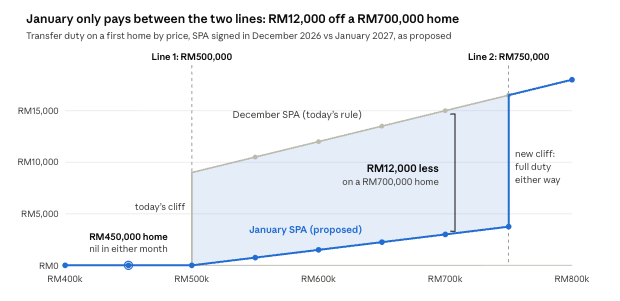
Below Line 1 the two rules sit together at zero, above Line 2 they meet again, and only in between does a January signature pay.
The developer’s calendar and the stamp office’s calendar. Year-end targets live on one. Your exemption lives on the other, and that one reads only the date on your SPA.
A discount you negotiate and a discount you schedule. Talking RM12,000 off a RM700,000 price is a hard conversation. Asking whether the SPA can be signed in the first week of January is one question.
The 10-minute check before you sign your SPA
Tonight, find two pieces of paper: your booking form (or the offer letter, on a subsale) and the bank’s letter of offer. Write down three dates: the SPA deadline on the first, and the acceptance and loan-document deadlines on the second. Then put your price against the two lines. Ten minutes, start to finish.
| Your first home’s price | SPA in December 2026 | SPA in January 2027 | What to do |
|---|---|---|---|
| RM500,000 or less | Fully exempt | Fully exempt | Sign when you’re ready |
| RM500,001 to RM750,000 | No exemption | First RM500,000 exempt, half off the rest | Aim for January if the price, the unit and the loan offer will hold |
| Above RM750,000 | No exemption | No exemption | The date won’t change your stamp duty |
Close to either line? The current rule tests the government valuer’s figure, not just your price, so ask your lawyer which number the new one will use.
If you’re between the lines and all three dates reach past the first week of January, send your lawyer one question tomorrow: ‘Can we execute the SPA in January, and is the new exemption order out yet?’
The best discount on your first home this year may not be on the price. It may be on the date.
- Run your numbers: the home loan calculator is free and asks for nothing.
- Talk it through: iMoney Home Advisory will look at your loan, your dates and your options with our partner Fintos Advisory; the first assessment is free.
- Compare rates: home loans from Malaysian banks, side by side, in case you have to apply again.
First home stamp duty exemption FAQs: questions buyers are asking
If the rule is gazetted as proposed, wait for January when your first home costs RM500,001 to RM750,000 and the unit, price and loan offer will hold: a January 2027 SPA saves five figures in transfer and loan agreement duty. At or under RM500,000 both months are fully exempt; above RM750,000 neither is. That is the two-line check.
About RM14,700 in this illustrative example, if the SPA is signed from 1 January 2027, as proposed: transfer duty falls from RM15,000 to RM3,000, and loan agreement duty on a 90% loan from RM3,150 to roughly RM450. The two-line check gives your own figure.
No. In the two-line check, the date that counts is when the sale and purchase agreement is executed. A booking fee, booking form or the bank’s letter of offer doesn’t decide which rule applies. Check your booking form’s SPA deadline before asking for a January date.
Not yet, as far as we could confirm on 3 November 2026. It was announced on 9 October as a proposal for SPAs executed from 1 January 2027 to 31 December 2030. The gazetted exemption order gives it legal effect, so confirm the final wording with your lawyer before the two-line check decides your signing date.
Under the current rule, you must be a Malaysian citizen who has never owned any residential property, including one inherited or gifted, whether alone or jointly. The exemption covers one unit within the price cap. The two-line check assumes Budget 2027 keeps these conditions; the gazetted order will confirm them.
Transfer duty falls by RM9,000 plus 1.5% of the price above RM500,000. At RM600,000 that is RM10,500, at RM700,000 RM12,000 and at RM750,000 RM12,750. Add the loan agreement saving, which is an estimate until the order says how the 50% applies to loans above RM500,000.
As proposed, yes. Both the instrument of transfer and the loan agreement are covered for SPAs executed from 1 January 2027 to 31 December 2030. Above RM500,000, the first RM500,000 is fully exempt and the rest is 50% exempt. How the split applies to a loan agreement has not been spelled out in the sources we checked, so treat loan figures as estimates.
As proposed, there is no exemption above RM750,000, so the SPA month does not change your stamp duty. On a 90% loan, a RM760,000 home pays about RM20,200 in transfer and loan agreement duty, against about RM4,200 to RM4,300 at RM750,000.
The current rule tests the market value set by the government valuer (JPPH) after the transfer is submitted to LHDN, not just the price on your SPA. The Budget 2027 announcements refer to the price of the home. Ask your lawyer which figure the new order will use, especially within a few thousand ringgit of RM500,000 or RM750,000.
It is disputed under the current rule. The Stamp Act definition of residential property includes serviced apartments and SOHO used solely as a dwelling, but LHDN’s statutory declaration template excludes them. In April 2026 the Bar Council said it would ask LHDN to amend the template. Check with your lawyer before relying on the exemption for these unit types.
Under the current rule, a co-purchaser who has never owned any residential property can claim the exemption for their own undivided share, even if the other buyer has owned a home. The wording of the new order will confirm whether this carries over.
Compare the numbers. On a RM700,000 home, a RM5,000 rebate does not beat the RM14,700 January saving, but a RM20,000 rebate does. Also weigh price validity, the unit you want and your bank’s loan offer deadline.
The exemption order gives the rule legal effect. When the exemption was last redrawn, the orders were gazetted on 10 February 2021 and deemed to start on 1 January 2021. Ask your lawyer whether the new order is out and how they will handle stamping if it is not.
Under the current rule, your lawyer applies to LHDN with a statutory declaration affirmed before a Commissioner for Oaths, confirming the price is within the cap, the property type and that you have never owned residential property. The form may change under the new order, so your lawyer will confirm the latest version.