
From M. Nasir To Umar Akmal: Can Musicians Still Make It In Malaysia?


Most Malaysians know music maestro Dato’ Mohamad Nasir bin Mohamed, or M. Nasir, for his prolific songwriting across four decades, but few would know that in the 1970s, he was just like any other musician struggling to get by.
“Only the main ones [found making money from music easy]. To be an accomplished performer, they had to go through many tests on the way to the top, such as being a good musician, having friends who are good [at playing music] and forming a good band, but that’s not always easy.
“In many bands that were formed at that time, only ten percent could be called good bands. So these ten percent are those we hear of. That ten percent happens today as well.
“There’s so many people. You can be a musician anytime you like but to be successful, it’s another thing. And you are one of them who’s chasing that ten percent,” he said, from his Luncai Emas office in Sungai Buloh.
This struggle is not unique to M. Nasir’s generation. It remains to be a defining challenge block for the industry to this day.
“The world’s changing, [and it’s] been changing since then, but the struggles are the same, just that technology has changed, culture has developed, the way that people think and live.
“Back then, musicians always came from the clubs, they were working class musicians. When they want to be a musician, they would be working to be a musician, working in some place. From there, they’ll get noticed and get into the recording industry,” said the Mentera Semerah Padi singer.
That pathway has all but disappeared. The live-music pubs of the 1970s and 1980s are gone, and hotel circuits that once supported full bands now settle for two-piece acts backed by a drum machine, if they book live music at all. This shrinking ecosystem is precisely what makes sustainability such a central question for musicians today.
Echoing that concern, Persatuan Pemuzik Malaysia (PPM) deputy president Edwin Nathaniel warned in 2020 that many musicians age into poverty, particularly when stricken by illness and an inability to earn a living. Often organising fundraisers for veteran players, the organisation focuses on live circuit musicians, not those who had recording or songwriting careers with long-paying royalties.
“Many musicians did not have a stable income. They were paid on an ad hoc basis depending on performance contracts. Therefore, when they hit retirement age, you might find they do not have EPF, SOCSO or medical insurance to help them,” Edwin was quoted as saying in Malaysiakini.
These days, M. Nasir acknowledged, the learning curve for musicians to hone their craft is much steeper.
“Today, everybody who’s got the knack for writing songs or playing music can be a recording artist. You know, that is a big difference. So everything has to be fast. You come and say you want to be a musician. Right away, you must be recognised. But in the old days, not really, you could be tested many times,” he said.
It’s against this backdrop that younger musicians like me are trying to build a sustainable career.
My turn as a cog in the machine
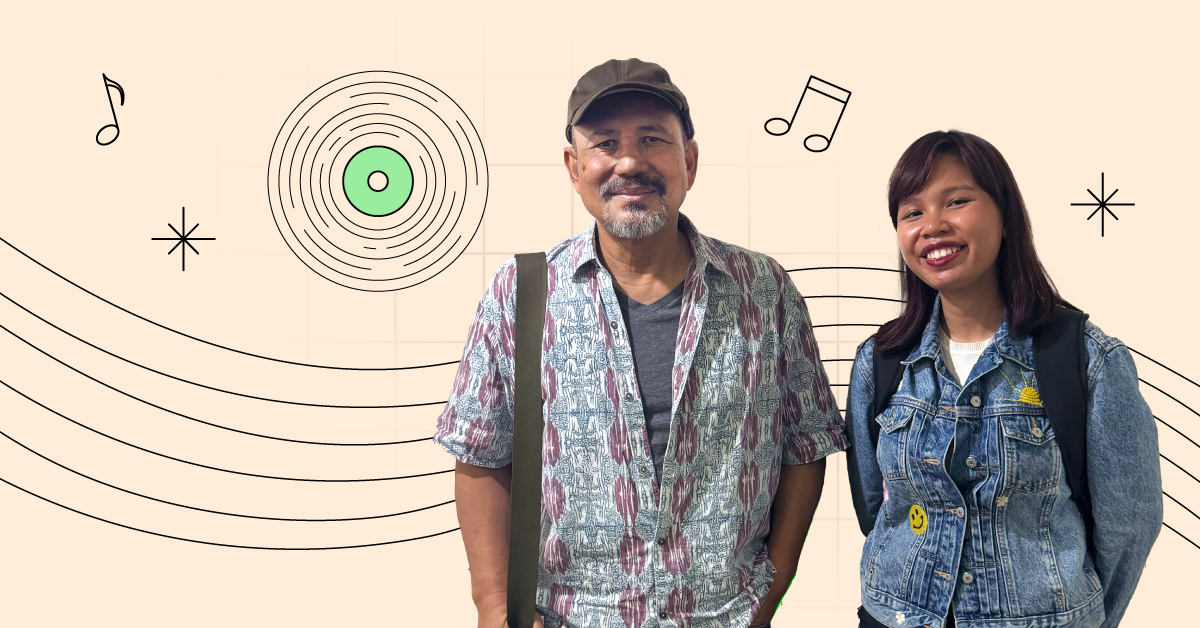
I was 24 when my folk-rock band Faye Faire released its debut album In My Mind in February 2024. The ten songs about love, grief, friendship, and the plight of the Orang Asli that formed the basis of this album are deeply personal. The share of the songwriting was split evenly between myself and an eighteen year old I-Shan Esther, who I started the band with in her TTDI home. She passed away in June 2023, just as we began laying down early tracks.
The album became a vehicle for my grief, giving myself and those who loved her some closure. It documented her talent and promise, so every ounce of energy, time, and money went into finishing what we started together. Suddenly I wasn’t just a songwriter. I was a co-producer, video editor, graphic designer, publicist, event organiser and salesperson. Like most independent musicians in Malaysia, I had to learn how the entire ecosystem worked just to get our music heard.
Faye Faire – Siren (Official Music Video):
None of it was cheap. Even a stripped-down single can cost RM1,000; a full album can stretch to RM60,000 or more once you factor in recording, mixing, mastering, printing CDs, and merchandise. It’s not a hobby for the broke.
Live shows help in recouping costs, though not always. When we were starting out, most gigs paid a few hundred ringgit at best; only the occasional festival or corporate show pushed into the thousands, with bigger bands being able to ask for more.
That year, Faye Faire played 14 shows; most self-organised, many at a loss. We even went across the Causeway to reach a new Singaporean audience, only to break even through ticket and merchandise sales. On good days, the music would supplement the income I was getting as a news journalist. On bad days, it did more harm than good.
Shifting from analog to digital formats hasn’t helped; physical sales of CDs, cassettes and vinyls have become harder to rely on, now that most people don’t even own the equipment to play them on.
All this taught me that making music today isn’t just composing. It’s learning how to make your work visible. Otherwise what is the point? Between studio fees, rehearsals, self-funded shows, unpredictable turnout and shrinking venue options, music often feels like unrequited love. We give and give, and on most days, receive very little in return.
So, it was a bit of a wake-up call when M. Nasir reminded me that this so-called norm shouldn’t be the case. Yes, it is important to survive but do not forget you are a musician first.
“But an artist is an artist. I mean, he’s not a businessman. He might not be a businessman, but he might be a businessman. He might be a good manager. We don’t know, but those who can manage, better manage their own works,” said the 68-year-old singer, before telling the tale of The Beatles who, at the height of their fame, struggled to self-manage their works through Apple Corps following the death of their manager Brian Epstein.
Making music, making money
In 1990, M. Nasir founded his music publishing company Luncai Emas in 1990 to manage and protect his growing catalogue, a step few musicians today can afford or manage themselves.
When I asked him how musicians can sustain themselves financially, the singer-songwriter admitted that many in the industry still struggle to understand how to make money. In the analog era, royalties were slow and small, and a band could wait up to six months, just to get a meagre ten percent cut from record sales.
“Many recording bands make it on the radio. We listen to them but we wouldn’t know the sales of records. In the 1980s, the biggest [Malaysian] artist only sold 20,000 records, but you need to sell at least 50,000 to become a major artist.
“Today, you see views or digital sales. One million, two million, all that. In our market, one to two million is considered big. But in a place like Indonesia, it’s not that much. But then [hitting that] one million means you’re one of them. One million views on YouTube or any digital platform, you are an artist. You are there, but you are not going to be very big,” he shared.
“That’s how we judge it in the industry. How many views you get matters. But if your goal is just to reach your people, maybe one million is enough, and that’s okay. To really be big and make it a full-time career, that’s another question,” added the singer.
The art form that does not love us back
Singer-songwriter Umar Akmal began in the university circuit in Johor and Sarawak in 2020, performing 20 to 30 shows since then.
“I used to tolerate no-pay gigs to put your face out there. If organisers offered a token, that’s okay. If you’re my friend, that one I don’t mind because it’s about building community,” he told me.
Community remains central to his work. Umar, an educator by day, won widespread praise for his Anugerah Lagu Indie performance of Dewasa Yang Ku Impikan in July, a wistful reflection on adulthood and disillusionment.
“Because, in Malaysia, our scene is quite small, compared to many countries. Our music scene is so inward. We’re not like Indonesia, where [exporting music] is a big part of it. Because of that, we cannot expect our music to bring food to the table if we don’t wear multiple hats.”
Wearing multiple hats often means wanting creative control, or simply not having the budget to hire professionals.
“You know music here won’t necessarily make you a lot of money, so you learn to cut costs as much as you can so that you can make those [songs] but at the same time, the collaborative process is actually very important for me,” said the 28-year-old singer-songwriter, stressing that being realistic is the compromise many musicians have to make.
Umar Akmal – Dewasa Yang Ku Impikan (Pentas Akhir #ALI2024):
Earlier this year, he worked with producer Aiman Zamir Adnan and flautist Zurfahani Batrisya, putting together a performance that saw the crowd roaring by the end of the song. Yet financially, little changed.
“I’m not saying, ‘I still have no future in music or people in the industry don’t care about it.’ There’s too many things going on in my life. I landed a new job and have to adapt to it. We’re working on new stuff,” he said.
He added that the biggest shift has been in how others perceive him. “People are noticing me as an artist. Sometimes I’ll see someone I look up to, and they’ll actually know me now because of that performance. So it feels nice.”
Seeking recognition from Malaysia and beyond
A handful of Malaysian artistes have found an international audience. Some acts like Zee Avi and Yuna found their way onto the international stage by embracing social media in its early days, making music in their bedrooms and uploading it onto YouTube and MySpace.
Signed to New York label FADER Records, Yuna would go on to become one of Malaysia’s biggest international success stories, collaborating with David Foster, Pharrell Williams and Usher among others.
Zee, on the other hand, was signed to the Los Angeles record label Brushfire Records by Hawaiian singer-songwriter Jack Johnson. She became the first Malaysian singer to have albums on the US Billboard Hot 200 Albums chart and top a Billboard chart. Her self-titled debut album also landed on the Top 10 Albums of 2009 by Associated Press alongside releases by well-known American acts such as Mariah Carey, Jay Z and The Black Eyed Peas.
Both Yuna and Zee spent much of their twenties building their careers overseas before eventually returning home.
Their respective journeys highlight something M. Nasir sees as central to building a sustainable music career today. “It’s good to have the ambition to be a musician,” he said, but whether that ambition is sustainable depends on how an artist approaches their career and how widely they are accepted.
In the digital age, he believes musicians can no longer afford to think only in local terms.
“With this digital thing, it’s an international thing. You are an international artist already,” he said, encouraging younger acts to think beyond national borders if they hope to go further. Would Yuna and Zee Avi’s career still have happened in an earlier age without the aid of the internet, breaking them to an international audience?
Songstress Shila Amzah is another example of an artiste who has built a devoted following, particularly in China, where she performed on reality talent shows like Asian Wave in 2012 and I Am A Singer in 2016. Yet her success was not linear. She has spoken openly about financial strain during the pandemic and the need to rebuild her career from scratch since then.
Local funk-soul sensation Saint Kylo gained international recognition through the Jameson Distilled Sounds 2025, a platform that enabled him to spend some time in Ireland being mentored by Grammy-winning rapper and producer Anderson .Paak. Kylo had also previously opened for international acts like Joss Stone, Mac Ayres, and Toploader.
Malaysian girl group DOLLA has also begun building an international fanbase, with listeners in China, Germany, Brazil and beyond. They recently made headlines for controversy surrounding revealing outfits worn in a music video, with the issue drawing attention even from the New York Times. Often compared to K-pop acts, their polished, contemporary sound and ability to perform in both Malay and English has helped them resonate with audiences outside Malaysia.
Building a sustainable music ecosystem
Umar believes that a sustainable music ecosystem begins with education and appreciation.
“You can have all these grants and labels who can realise your vision, but in the end, if no one’s appreciating it, then it’ll be a waste of money, time, energy and creative juice. It starts with the audience. When people appreciate the arts, the audience will grow,” he said, adding that the funding will follow the masses.
Still, he added, musicians can’t wait for institutions to fix everything.
“The government has to play a role [in this]. They have to step up. They have to do something about it. They have to restructure how they think of art and how they position art in Malaysia. But [at the same time] we cannot just rely on them because if we rely on them, it will take forever, right?
“So we are the ones who should actively do what we can. Get involved in whatever way we can to just make sure this new generation will appreciate [the arts] better,” said Umar.
Neo-psychedelic group Ramayan frontman Syafi’i Nasir, better known as Pi’e, agrees. For him, cultural appreciation is deeply tied to economics.
“For you to appreciate culture, [the public] need to know what culture brings them [and] what culture means to a progressive society. Most people are not thinking about that,” said the 31-year-old singer, whose father is, incidentally, M. Nasir.
Appreciation grew among young Malaysians post-pandemic, as people rediscovered local music. Yet ironically, many live music venues shuttered during this period, unable to adapt. For me, the loss felt significant. These clubs, pubs and indie venues reflected our long-standing history of cultural diversity and kept the music alive despite the odds, where big music acts like Ella, Hujan, Yuna and others first learned to face their audience.
In 2020, Malaysian Buskers Club president Wady Hamdan estimated losses of over RM10 million in the first two months of the MCO alone. Some buskers sold homemade food at bazaars. Others resorted to pawning off their instruments, disappearing from the scene altogether.
What is being done
For Budget 2026, the government set aside RM140 million for arts and culture, making up just 0.03% of the national budget. Compared to countries like South Korea, which invests heavily to become a cultural powerhouse, it’s clear the arts are still seen as peripheral here.
While it is a marked increase from the 2025 budget, it strikes me that without real investment and hands-on engagement, the infrastructure we rely on such as grants, education, venues remains fragile, leaving musicians to navigate an unpredictable ecosystem alone.
That said, efforts are being made to change that. During RIUH ASEAN 2025, Communications Minister Datuk Fahmi Fadzil proposed a National Music Day to give support and recognition for local musicians. The initiative aims to address issues like royalties, employment opportunities, and the promotion of Malaysian music internationally.
Hopefully, it is a step in the right direction towards a society that is more considerate towards its artisans and building an ecosystem where young musicians like Umar and myself can make music a viable career.
So, maybe the question isn’t how many hats we wear, but whether we even have a choice.
As an independent musician in Malaysia, I’ve shouldered production, promotion and live performance all at once and have seen countless others bear the same burden in their respective acts. More support and appreciation of the arts could change that for us, letting us focus on what we do best.
Funnily, it was through my interview with M. Nasir that this truth hit home. This idea that at the end of the day, the music should always come first.
He stressed that passion is the foundation of being an artiste. “When I was starting, I shouldn’t be thinking of all these things, because I’m an artiste. I should have been just creating things and doing whatever I like,” he said.
Beyond the struggle to survive, there is a deeper joy that most musicians have in exploring the unknown and bringing a song to life.
“To me, to get up in the morning and try to create a song for me or other artists is a huge challenge. That gives me the fire to go on because before writing that song, there’s no song.
“But after that there is a song, and the song is recorded. You can hear what was before–nothing, so that mystery is always keeping me going,” he said.
Taking a cue from his words, I’ll have to learn to trust the process as a fellow musician, letting the mystery guide me as it did him and chart a path for those who follow, even if the destination remains unseen.
FAQ
To become a singer in Malaysia, you need exceptional vocal skills, industry knowledge, and relentless networking, achievable through formal music education (UCSI, UM, MIA), joining talent shows (Akademia Fantasia, Big Stage), building an online presence (YouTube), performing gigs, and constantly connecting with industry players for exposure and opportunities, blending talent with business savvy.
Yes, you can make a living as a musician in Malaysia, but it’s challenging and requires diversification beyond just gigs, often involving teaching, online content, session work, or corporate events, as relying solely on live performance income is difficult; most successful musicians blend multiple income streams or find niche markets.
The average musician salary in Malaysia varies, but data suggests around MYR 111,000 annually (approx. MYR 9,250/month), with ranges from RM 78,000 to RM 135,000, though lower figures like RM 60,000 (RM 5,000/month) for some roles or starting pay are also reported, indicating significant fluctuation based on skill, location (KL higher), and type of work.
Singer payments in Malaysia vary wildly, from a few hundred Ringgit (RM) for new/indie artists at small gigs (RM 300-RM 1,500+) to five figures (RM 10,000+) for established stars, depending heavily on fame, venue, event type (corporate vs. bar), negotiation, and if it’s a full band or solo act, with some popular bands earning thousands per show and experienced musicians potentially earning RM 5,000-RM 20,000 monthly average.